
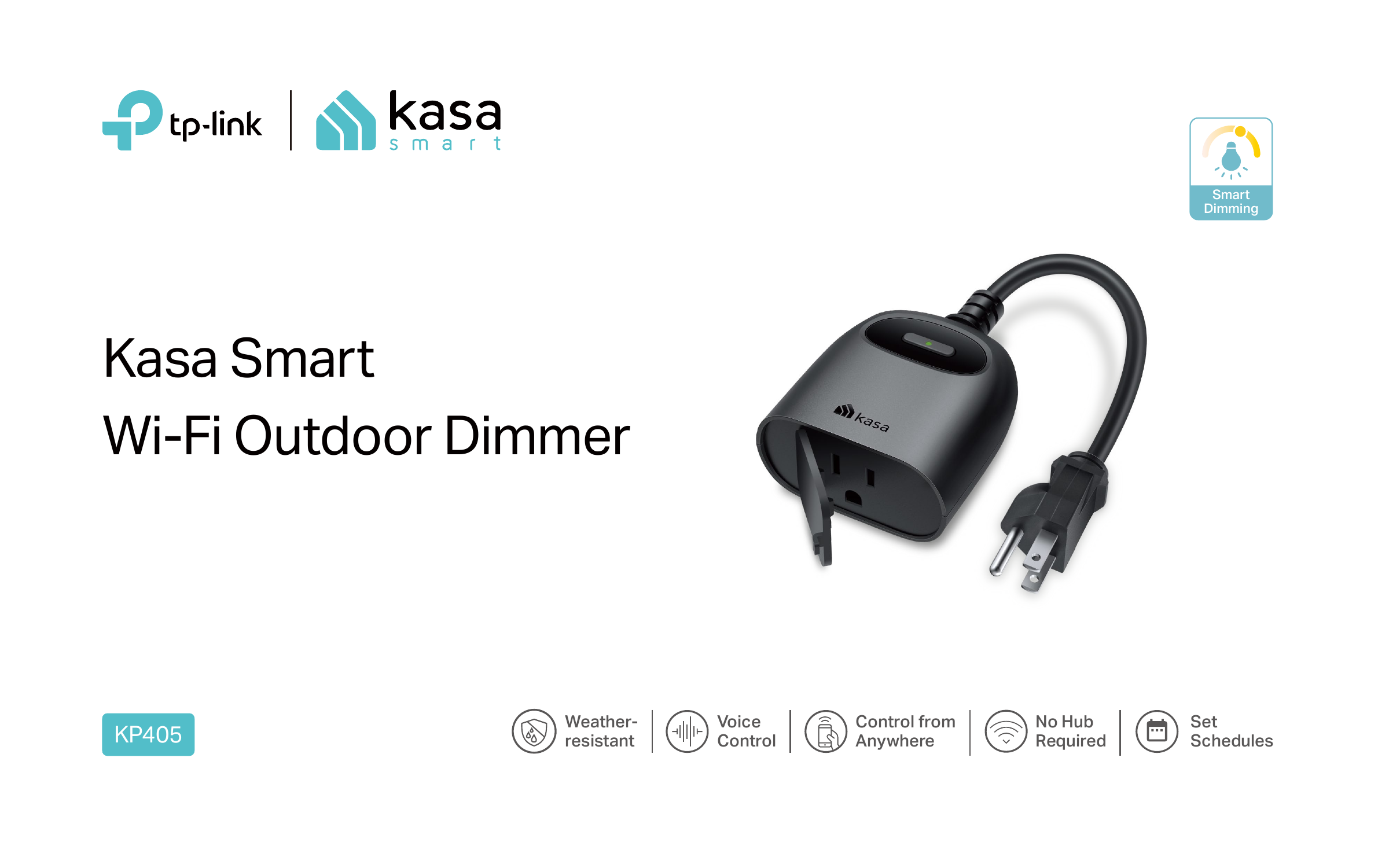
Your needs, this model
Does it fit your priorities?
Is the KP405 an ordinary on/off outdoor plug for any appliance?
No. TP-Link describes the KP405 V1 as a plug-in dimmer for compatible dimmable lighting, not a general-purpose 15 A pass-through. The V1 datasheet gives a 300 W incandescent ceiling and a 150 W dimmable LED (MLV) ceiling; it does not establish a broad current or motor rating. Confirm the bulb's dimming type before using the dimmer.
Explore this need in the finder →What bulb and wattage limits apply to the KP405 V1?
The V1 datasheet specifies up to 300 W for incandescent lighting and 150 W for dimmable LED (MLV) lighting, and says to confirm the bulb's supported dimming method. Because this finder has no bulb-type question, its general wattage filter uses the conservative 150 W threshold instead of implying that every connected load can use the 300 W incandescent allowance.
Explore this need in the finder →Can the KP405 V1 run a schedule, countdown and Away Mode?
Yes, TP-Link's KP405 V1 user guide separately documents schedules, a countdown timer and randomized Away Mode in the Kasa Smart app. This does not mean those controls are available through every voice-assistant surface, and the guide does not establish local control during an internet outage.
Explore this need in the finder →Document-based assessment of the TP-Link US KP405 V1 one-pack route. It draws on the versioned product page, V1 datasheet, V1 user guide and lifecycle record; it is not a claim of ownership, setup or hands-on testing.
A dimmer with one outdoor socket, not a general-purpose smart outlet
The KP405 is a plug-in lighting control: one corded body, one controlled socket and dimming for compatible bulbs. TP-Link describes brightness adjustment from 100% down to 1%, four selectable preset levels and a physical button that cycles those presets. If your goal is to automate a heater, motor, pump, charger or miscellaneous appliance, do not treat the dimmer as a general 15 A pass-through. Its exact V1 product materials focus on lighting and do not publish a broad appliance current or motor rating.
Use the bulb-specific ceilings—not one interchangeable watt figure
The V1 datasheet names incandescent lighting up to 300 W and dimmable LED (MLV) lighting up to 150 W. It also identifies leading-edge TRIAC phase-cut dimming and advises checking the bulb maker's supported method. Confirm the lamp's technology and instructions, and verify its usable dimming range rather than assuming the app's low end will work without flicker.
Those limits are not one general household-load rating. The site finder asks for maximum appliance wattage at 120 V but has no question about incandescent versus LED bulb type. For that numeric filter, the KP405 has no broad, exact-version 120 V appliance ceiling entered; the 125 V datasheet's bulb-specific values remain visible in this review rather than being converted into a blanket watt figure. The finder also cannot certify bulb compatibility. This conservative treatment prevents the 300 W incandescent rating from being read as permission for an arbitrary 300 W load. Use the V1 datasheet and the exact lamp instructions together.
Kasa provides the documented routines
The V1 user guide describes setup through the Kasa Smart app and a TP-Link ID over a secured 2.4 GHz Wi-Fi network; the datasheet says a separate hub is not required for this route. It also documents scheduled on/off actions, preset brightness in a schedule, a countdown timer and randomized Away Mode. Those are useful distinctions for porch or patio lighting: a schedule can set a recurring light state, a timer can end a temporary use, and Away Mode varies switch times while the household is away.
The exact V1 documentation names Alexa and Google Assistant for voice control as well as the Kasa app. I found no matching V1 evidence for Matter or Apple Home, so those are not claimed here. Voice control does not mean that a third-party assistant exposes the Kasa app's brightness, schedule or Away controls in the same way. Likewise, the reviewed documents do not establish that a previously configured app can control the dimmer after an internet outage. If an offline route or a specific smart-home controller is essential, do not infer it from Wi-Fi or voice compatibility alone.
Outdoor rating still comes with precise installation instructions
TP-Link rates the KP405 IP64 for dust and splashes, but the V1 user guide says not to expose it to heavy rain or immerse it. It instructs the installer to orient the housing downward, keep it at least two feet above ground, use the mounting tag and cap the socket when it is not in use. The datasheet separately says to use a GFCI receptacle for outdoor or wet-location use. A weather-resistant enclosure does not replace that receptacle protection, make an indoor bulb or appliance suitable outdoors, or promise submersion resistance.
The product route lists a six-inch cable and includes a clamp, screw and quick-start guide. The body measures 3.1 × 2.8 × 1.5 inches in the manufacturer's H × W × D order. That is useful for checking the outlet and attachment point, but it is not a clearance drawing: allow for the short cable, the lamp plug, mounting hardware and access to the button and protective cover. The datasheet lists an operating range of -4°F to 122°F and 10%–90% relative humidity, non-condensing. Those conditions are not an assurance about every exposure, installation or lamp.
Version and lifecycle matter before a seller search
The TP-Link category route is KP405, while its selected US product page identifies the V1 one-pack route. The support selector exposes several V1-family branches, including V1, V1.26, V1.28, V1.60 and V1.80; the V1.0 EOL record therefore should not be used to claim that every possible seller suffix is identical. TP-Link's US EOL V6.0 table lists KP405 V1.0 with an end-of-sale date of February 20, 2026. This assessment keeps the V1 route in the earlier-model group. It does not establish what stock remains, a seller's condition, warranty coverage or which suffix is in a listing. Check the label on the device or package and obtain return terms before relying on the assessment.
For an outdoor product that only switches an appliance on and off, the EP40M is a different two-outlet Matter plug with its own shared load limits and setup route; EP40A is an earlier dual-outlet HomeKit option. Neither is a substitute for the KP405's specific light-dimming task. In turn, the KP405's dimming feature does not make it the broad-load choice. Read the outdoor installation guide and load-limit guide, then compare the exact model evidence for EP40M and EP40A if on/off control is what you need.
What the evidence does not establish
The reviewed sources do not establish a general current or motor rating, energy monitoring, Matter, Apple Home or local control after internet loss for this V1 route. No radio-range, weather-endurance, dimming-flicker, reliability or energy-accuracy test was performed for this assessment. A CPSC SaferProducts query for the exact KP405 name returned an empty result on October 29, 2026; that is a dated database screen, not a safety guarantee. Confirm the exact hardware suffix, bulb type, GFCI receptacle, mounting conditions and seller terms before purchase or installation.
Key specifications
Key details at a glance
| Controlled outlets | One controlled outlet per plug |
|---|---|
| Reviewed package | 1-pack |
| Motor limit | No separate motor rating is established; the exact V1 sources describe compatible dimmable lighting, not a general-purpose appliance relay. |
| Body height | 3.1 in |
| Body width | 2.8 in |
| Body depth | 1.5 in |
| Network and protocol | Secured 2.4 GHz IEEE 802.11 b/g/n Wi-Fi with the Kasa Smart app and TP-Link account; the V1 datasheet says no separate hub is required. |
| Indoor use only | No |
| Outdoor rating | Yes |
| Schedules documented | Yes |
| Countdown timer / auto-off | Yes |
| Away Mode | Yes |
Use the exact model’s instructions for operating limits, supplied equipment and version differences.
Sources for this review
Sources for this assessment
Check the exact version against your own outlet
The finder checks documented ratings and features; it cannot approve your appliance, outlet wiring or physical clearance.