
Your needs, this model
Does it fit your priorities?
Which lamps can the P135 dim?
TP-Link specifies incandescent/halogen up to 300 W or LED up to 150 W and leading-edge TRIAC phase-cut dimming. Both outlets control lamps together; use matching lamp type, dimming method and load, and verify the bulb maker’s instructions.
Explore this need in the finder →Can the two outlets dim independently?
No. TP-Link describes simultaneous control of two lamps and requires the same fixture type, dimming type and load on both outlets. The included dimmer button is bound to this plug and cannot be reused on its own.
Explore this need in the finder →Does the wireless button need a hub?
TP-Link says the bundled button is paired to the dimmer and does not require a hub. For a third-party Matter app such as Apple Home, use a compatible Matter controller; those are different control paths.
Explore this need in the finder →Document-based assessment of TP-Link’s US Tapo P135 KIT route, using its US product page, V1.6-labelled support materials and current product specifications. I did not set it up, connect lamps or test its dimming.
A lamp dimmer kit, not a universal smart outlet
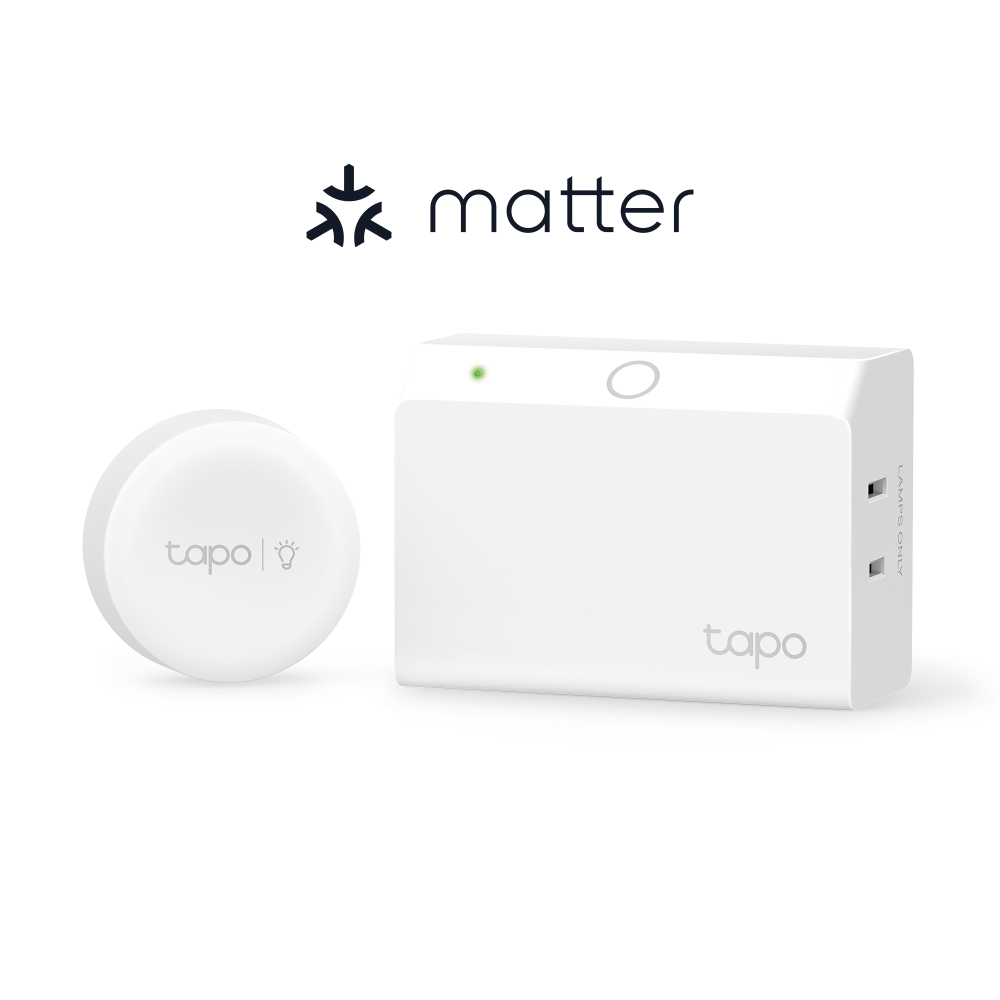
The P135 KIT is a plug-in controller with two receptacles and a separate wireless dimmer button. TP-Link describes both receptacles as controlling two lamps simultaneously. That distinction matters: this is not two independently switched sockets, nor a general-purpose 15-amp plug for arbitrary appliances. The exact quick-start guide says to connect lamps only, not devices powered by adapters, and not smart lights. Treat it as a narrowly defined lighting control rather than a miniature power strip.
The included button is part of the kit’s use case. Its touch and rotary controls operate the connected lamps, but TP-Link says it is bound to the dimmer and cannot be used separately. The button does not turn this into a portable, standalone remote for other Tapo products. The outlets share the selected dimming behavior, so this arrangement makes sense only when both lamps are compatible with the same dimming type and have the same load.
Check the bulb and dimming method before relying on the watt number
TP-Link rates the unit at 120 V and 2.5 A maximum, with separate bulb ceilings of 300 W for incandescent/halogen lamps and 150 W for LED lamps. It identifies leading-edge, TRIAC phase-cut dimming. Those are not interchangeable limits for an unspecified appliance: the lower LED figure is not a blanket allowance for every LED lamp, and the 300-watt incandescent/halogen ceiling does not mean the sockets can safely switch a heater, motor, power adapter or any other device. The manufacturer explicitly says the two lights should share the same load and dimming type, and advises recalibrating the brightness range after a bulb change.
Before choosing it, check each bulb’s packaging or manufacturer instructions for dimmability and the supported phase-cut method. Avoid pairing unlike fixtures, mixed lamp technologies or a smart bulb whose own electronics expect continuous power. If you want a plug to switch an appliance on and off rather than dim a matched lamp pair, the P135 is the wrong kind of device. The finder therefore treats “dimmable lamps only” as its own load task; it does not treat this model as a match for a general resistive appliance or for a motor.
App, Matter and the button are different control routes
The product page documents the Tapo app, Bluetooth-assisted onboarding and a 2.4 GHz Wi-Fi connection. It also identifies Matter, Alexa and Google Assistant and gives Apple Home as an example of a Matter-compatible setup app. A compatible Matter controller is required for the third-party Matter path; that is separate from TP-Link’s statement that the bundled dimmer button needs no hub. Do not read the button’s “no hub required” note as a promise that a third-party Matter controller is unnecessary.
TP-Link documents schedules and Away Mode, plus app and voice control. Its materials do not establish energy monitoring or control through the Tapo app on the local network after an internet outage. I would not infer either feature from Wi-Fi or Matter alone. The main product page also names the button’s paired behavior and simultaneous lamp control; it does not establish separate dimming for each outlet or that every assistant exposes the same brightness controls as the Tapo app.
Dimensions, supplied pieces and environment
The US product page lists one dimmer plug, one dimmer button, a shim and a quick-start guide. The plug body is 2.2 × 3.0 × 1.3 inches in the manufacturer’s height × width × depth order; the button is a separate 1.7-inch-diameter, 0.67-inch-high piece. Measure the wall plate, neighboring socket, both lamp plugs and the button’s reachable location. The body dimensions do not describe the space needed for two connected lamp plugs or prove that both receptacles are accessible in your setup.
The US datasheet says not to use the kit in damp environments or outdoors and specifies a 0–104°F operating range. It is an indoor lighting product, not an outdoor dimmer. The button uses a CR2032 coin cell; keep the battery and device away from children and follow the manufacturer’s battery-safety instructions. The product route and current support page show V1.60, while the documents carry V1.6 labels that TP-Link maps to the V1.60 family. A seller listing still does not prove the label on its unit, so check the hardware marking and included kit before depending on these details.
What this evidence does—and does not—settle
The strongest fit is a pair of compatible indoor lamps that should dim together, with app, voice or Matter-based control as useful options. The tradeoff is real: the two outlets are linked, bulb compatibility determines the result, and the watt limits vary by lamp type. No hands-on dimming, flicker, range, reliability or energy-accuracy test was performed for this assessment. The exact-name CPSC SaferProducts query returned an empty array on October 29, 2026; that dated search is not a safety warranty or a guarantee about future recall status. Verify the bulb, shared load, Matter controller, package and model label before ordering or installation.
Key specifications
Key details at a glance
| Controlled outlets | Lamp dimmer kit |
|---|---|
| Reviewed package | 1-kit |
| Maximum current | 2.5 A |
| Motor limit | No motor rating; the V1.6 materials describe a lamps-only dimmer and warn against connecting products powered by adapters. |
| Body height | 2.2 in |
| Body width | 3 in |
| Body depth | 1.3 in |
| Network and protocol | 2.4 GHz IEEE 802.11 b/g/n Wi-Fi; Bluetooth for setup only; Matter setup through a compatible Matter app/controller. |
| Indoor use only | Yes |
| Outdoor rating | No |
| Matter controller for third-party app | Yes |
Use the exact model’s instructions for operating limits, supplied equipment and version differences.
Sources for this review
Sources for this assessment
- TP-Link US smart-plug catalogue, page 1
- Tapo P135 KIT US product page
- Tapo P135 KIT US support page and V1.60/V1 documentation selector
- Tapo P135 KIT US V1.6 datasheet
- Tapo P135 KIT US V1.6 quick installation guide
- TP-Link Tapo Matter US quick installation guide for plugs
- TP-Link Tapo app guide for plugs
- CPSC SaferProducts exact-name query for Tapo P135 KIT
- Official Tapo P135 KIT product-page image

Check the exact version against your own outlet
The finder checks documented ratings and features; it cannot approve your appliance, outlet wiring or physical clearance.