
Your needs, this model
Does it fit your priorities?
Can the P110 V1 report energy and still run a schedule?
The US V1 product page and datasheet describe energy-use statistics, bill estimates, weekly schedules, countdown/Auto-Off and Away Mode in the Tapo system. Energy reporting is not a substitute for checking the device label, and third-party voice control does not imply that the same energy dashboard appears in every platform.
Explore this need in the finder →Will Tapo control the P110 if the internet connection drops?
TP-Link says the connected P110 remains accessible in the local network through the Tapo app when the household is offline. This describes LAN access after setup; it does not promise access from outside the home, preserve a broken Wi-Fi network, or establish independent local control from Alexa, Google Home or SmartThings.
Explore this need in the finder →Is the P110 a fit for a 1,500 W incandescent load or Apple Home?
Do not apply the general 1,800 W figure to an incandescent lamp: the P110 US V1 documents an 8 A incandescent limit, or 960 W at 120 V. The checked US route lists Tapo, Alexa, Google Assistant and SmartThings but does not document Apple Home or Matter. Check exact device instructions and platform support before choosing it.
Explore this need in the finder →Assessment basis: this is a document-based assessment of the TP-Link US Tapo P110 V1 one-pack route. I have not installed, measured, operated or load-tested the plug. TP-Link's selected product page identifies one P110 in the package, while the support library lists a separate later V1.60 hardware branch; a seller's printed suffix still matters.
Energy reporting is the main difference from the P105
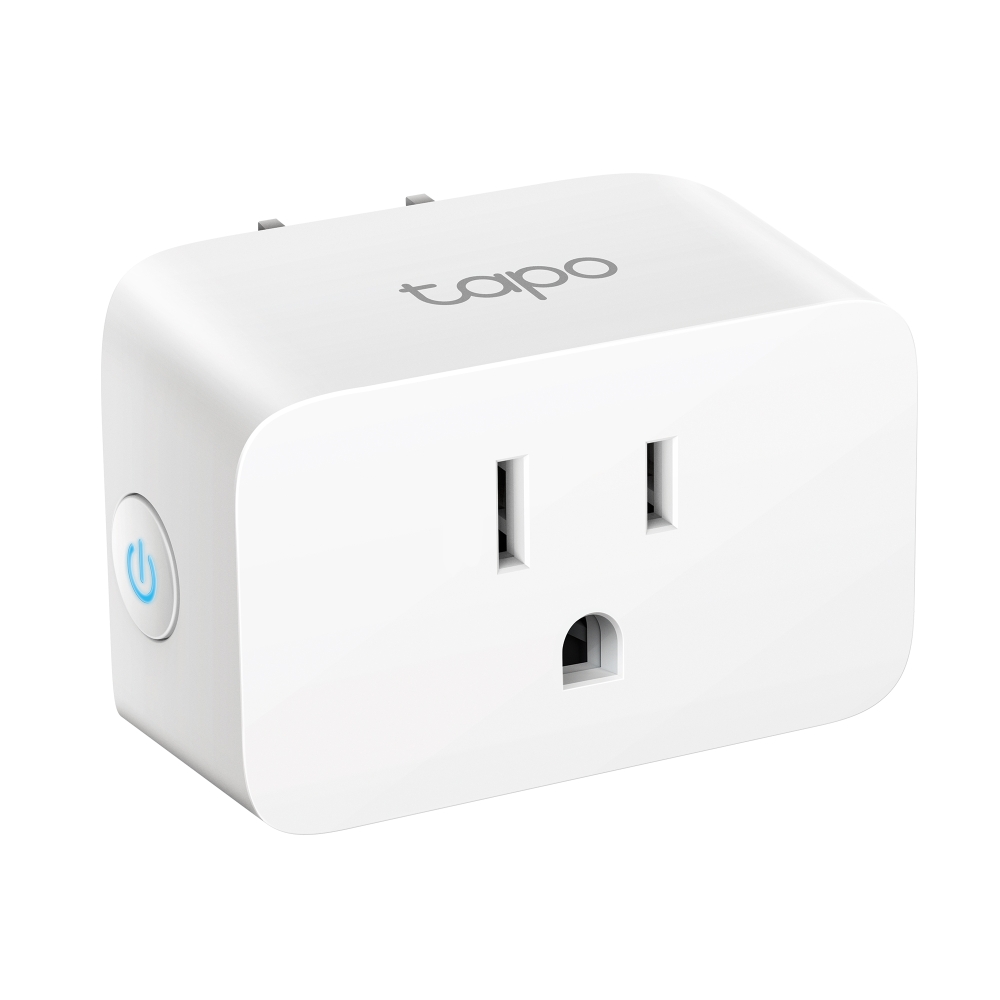
The P110 is an indoor, single-outlet 2.4 GHz Wi-Fi plug controlled through the Tapo app, with Bluetooth used for onboarding. Its one-plug body is 2.6 × 1.5 × 1.6 inches (height, width, depth), somewhat larger than the P105's published 2.4 × 1.5 × 1.3 inches. Both families list schedules and Away Mode, but the P110's product page and US V1 datasheet add energy-use statistics, bill estimates, a power-threshold shutoff and Smart Charge Guard. These functions make the P110 the more relevant model when the user wants to see a device's reported energy consumption or use a documented automatic shutoff rule. Energy monitoring is not the same as an independently verified meter reading or a promise to save money. The sources describe app statistics and an estimated bill based on entered rates, not accuracy tolerances, calibration data or a comparison against a laboratory meter. Treat the graphs as app-reported information; do not use them to make safety decisions or certify energy savings. The charge-protection functions are also app features that need to be configured for a compatible load. They are not evidence that every charger or appliance will stop at the right moment.Electrical limits have separate load classes
For the reviewed US V1, TP-Link specifies 100–125 V, a 15 A / 1,800 W maximum for general/resistive use, an 8 A incandescent limit and a 1/6 hp motor limit. The 1,800 W figure must not be applied to every resistive-looking appliance: at 120 V, 8 A corresponds to 960 W for an incandescent load. Motors need their own horsepower and starting-current check, not just a comparison against the 15 A headline. Review the actual appliance nameplate and manual, and obey any lower device-specific limit. The P110 is not rated for outdoor or damp locations. A compact body still needs enough room for the wall plate, adjacent plug and attached cord; the published dimensions describe the plug body, not its whole installed envelope. Do not place it behind an appliance where the reset/power button or outlet becomes inaccessible. TP-Link's own instructions take precedence for connection, placement and load limits.Local access, schedules and the cloud distinction
The P110's Tapo page states that devices on the local network remain accessible through the Tapo app when the household goes offline. That is a useful, specific statement about LAN access after setup. It does not mean the plug operates without a working local Wi-Fi network, makes remote control from away available without internet, or proves that Alexa, Google Assistant or SmartThings will function in the same outage. The app remains part of the setup and control plan. TP-Link also lists weekly scheduling, countdown/Auto-Off and Away Mode. Those features are distinct: a weekly schedule repeats; Auto-Off ends an on-state after a set duration; Away Mode varies the times a connected light or other device is switched. The product page lists Alexa, Google Assistant and SmartThings. It does not document Matter or Apple Home for this US V1 assessment. If Apple Home or Matter is mandatory, choose an exact model and version with that route explicitly documented rather than inferring support from the Tapo brand.Who should shortlist it
The P110 is worth considering when a single indoor load fits the published class limits and Tapo energy reports, threshold protection or LAN app access are useful. It is a poor match for an outdoor outlet, an appliance above its motor allowance, or an incandescent device whose draw exceeds 8 A. It may also be the wrong choice for a buyer who requires Apple Home, Matter, an energy view inside a third-party app or a guarantee that voice control survives an internet outage. The exact seller item should say Tapo P110 V1, US, one-pack, and the plug label should be checked against the version being assessed. TP-Link's support pages separately list later revisions; this review does not carry the V1 facts over to V1.60 or resolve a seller's stock, condition or warranty. Check whether the existing router and Tapo account fit the setup requirements, then compare the actual appliance's voltage and load with the separate ratings above. An empty, dated CPSC name-query response is not proof of safety or a future recall status. This assessment reports manufacturer documentation only; it does not claim personal use, performance testing, customer satisfaction or measured energy accuracy.Key specifications
Key details at a glance
| Controlled outlets | One controlled outlet per plug |
|---|---|
| Reviewed package | US V1 one-pack; selected product page specifies Tapo P110 × 1 plus quick-start guide |
| Maximum current | 15 A |
| Maximum published watts at 120 V | 1800 W |
| Motor limit | 1/6 hp |
| Body height | 2.6 in |
| Body width | 1.5 in |
| Body depth | 1.6 in |
| Network and protocol | 2.4 GHz IEEE 802.11 b/g/n Wi-Fi; Bluetooth is used for onboarding only. Matter and Apple Home support are not documented for this US V1 route. |
| Indoor use only | Yes |
| Outdoor rating | No |
| Schedules documented | Yes |
| Countdown timer / auto-off | Yes |
| Away Mode | Yes |
Use the exact model’s instructions for operating limits, supplied equipment and version differences.
Sources for this review
Sources for this assessment
- TP-Link US smart-plug catalog, page 1
- TP-Link US Tapo P110 V1 product page and one-plug package
- TP-Link US Tapo P110 V1 support page and version options
- Tapo P110 US V1 datasheet
- Tapo P110 US V1 user guide
- Tapo P110 US V1 quick-start guide
- CPSC SaferProducts exact-name query for Tapo P110 (retrieved 2026-10-29)
Check the exact version against your own outlet
The finder checks documented ratings and features; it cannot approve your appliance, outlet wiring or physical clearance.