
Your needs, this model
Does it fit your priorities?
Can I schedule one KP303 outlet without switching the other two?
Yes. The KP303 V1 guide describes individual outlet control and separate outlet schedules. Its two USB charging ports are always on, not app-switched outlets.
Explore this need in the finder →Does the KP303 document a motor rating as well as a 15 A strip limit?
Yes. The US KP303 V1 user guide specifies a separate 1/6 HP motor load alongside a 15 A general/resistive limit. Those are different load classes; check the appliance label and instructions, including any startup requirement.
Explore this need in the finder →Is 1,875 W available independently at each of the three KP303 outlets?
No. TP-Link specifies a 15 A/1,875 W maximum for the whole 125 V strip. At 120 V, 15 A corresponds to 1,800 W total; connected AC loads share that ceiling, and the USB output has its own 5 V/2.4 A aggregate rating.
Explore this need in the finder →Three switched outlets, one shared strip limit
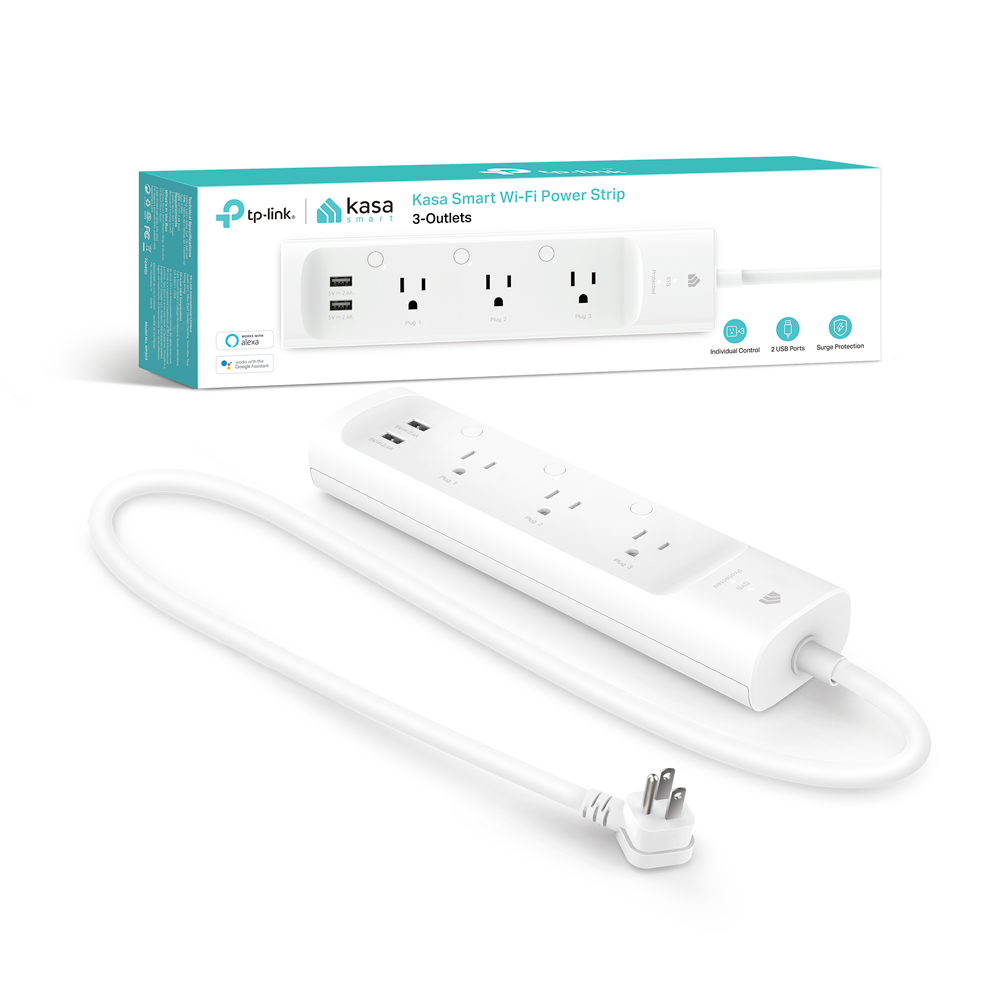
This is a document-based assessment of the US Kasa KP303 V1 one-strip route, not a hands-on review or an electrical test. TP-Link’s US catalogue identifies KP303 V1, and the version-specific product page lists one three-outlet strip plus a quick-start guide. The defining layout is three independently controlled AC sockets alongside two always-on USB charging ports. It is a small power strip, not three separate smart plugs and not an outlet extender mounted directly over a wall receptacle.
Each of the three AC outlets can be managed separately in the Kasa app; physical buttons are also provided for the outlets. The USB ports charge through a shared 5 V, 2.4 A output and are not smart-switched outlets. This layout can make sense for a desk or media corner where a few devices need their own schedules but USB charging can remain powered. It is less useful if every port must turn off together, if USB needs app control, or if the installation calls for only a single compact wall plug.
Do not read the “15 A / 1,875 W” specification as a per-socket allowance. The rating applies to the complete strip at 125 V, so simultaneous AC loads draw from one shared ceiling. At 120 V, 15 A corresponds to 1,800 W. Add the actual connected loads and check each device’s own label and manual; this arithmetic does not replace a maker’s separate load-class restriction. The USB output has its own lower voltage/current rating and should not be confused with the strip’s AC capacity.
Its motor figure is separate from its resistive rating
One helpful distinction in the KP303 V1 user guide is its US-specific load section: it lists a 15 A maximum general/resistive load and a separate 1/6 hp motor load at 125 V. That is more useful than assuming a high amp number means every appliance type is covered. A motorized appliance may have startup demands and instructions that matter independently of running wattage, so compare the device’s own rating to the separate motor limit before considering this strip.
This motor line should not be generalized to other Kasa strips or hardware revisions. It is tied here to the KP303 V1 US guide; if a seller’s unit has a different printed version, confirm its matching documentation rather than relying on a similar model name. The current materials do not establish a higher motor ceiling, and no substitute claim is made for loads whose own manufacturer forbids remote switching.
Kasa routines and the control boundary
The KP303 V1 guide documents individual schedules, a countdown timer and Away Mode in the Kasa app. A schedule can be assigned to a selected outlet; the timer is a countdown action, while Away Mode randomizes switching over a set period. Those are distinct routines rather than interchangeable labels. The documentation also lists Kasa, Alexa, Google Assistant and SmartThings control routes. The checked V1 material does not establish Matter certification or an Apple Home route, and third-party app support should not be assumed to expose every Kasa feature.
The strip connects to a secured 2.4 GHz Wi-Fi network and uses Kasa setup; the manufacturer says a separate hub is unnecessary for this arrangement. This does not establish operation without a router, offline first-time setup, or manual control in the Kasa app during an internet interruption. Likewise, the product is not documented here as an energy-monitoring strip. If those capabilities are requirements, compare a model with a direct source for the exact feature instead of inferring support from its app family.
Size, protection and edition checks
TP-Link lists the body as 10.2 × 2.5 × 1.5 inches, width by depth by height, and the weight as 1.08 pounds. The body is close to the finder’s 10-inch maximum-width range and therefore does not qualify for an entered width cap of 10 inches or less, even though the other dimensions are modest. Measure the actual placement, cord bend, wall socket and neighboring furniture rather than treating body dimensions as a clearance diagram. The strip is specified for indoor use only.
The data sheet lists ETL certification and Type 3 surge protection, but that is not a battery backup or a guarantee against every surge. Keep the outlets and strip within the maker’s instructions and do not assume the surge label changes the aggregate load rating. The 2026 TP-Link end-of-life list includes KP303 US V1.0 and V1.10 entries with a 2022 end-of-sale date. This assessment therefore labels the catalog’s V1 route as an earlier edition; it does not claim a seller has stock, that every unit is unavailable, or that any particular offer is genuine.
The KP303 is a plausible document-based option when three independently scheduled indoor AC outlets and always-on USB charging match the layout. Its limits are central to that decision: one shared AC rating, a 1/6 hp motor ceiling, no established energy reporting, a width just over the finder’s maximum, and an older US route whose exact suffix should be checked. Confirm the model label, package, hardware version, return terms and current seller details before buying; no price, availability, ASIN, customer rating or ownership experience is asserted here.
Key specifications
Key details at a glance
| Controlled outlets | Smart power strip |
|---|---|
| Reviewed package | 1-strip |
| Maximum current | 15 A |
| Maximum published watts at 120 V | 1800 W |
| Motor limit | The KP303 V1 user guide's US-version load section specifies 1/6 HP motor load at 125 V. Confirm the appliance's own instructions and startup requirements; do not infer a higher limit from the strip's aggregate resistive rating. |
| Body height | 1.5 in |
| Body width | 10.2 in |
| Body depth | 2.5 in |
| Network and protocol | Secured 2.4 GHz IEEE 802.11 b/g/n home Wi-Fi and the Kasa app; a separate hub is not required for the documented Kasa arrangement. |
| Indoor use only | Yes |
| Outdoor rating | No |
| Schedules documented | Yes |
| Countdown timer / auto-off | Yes |
| Away Mode | Yes |
Use the exact model’s instructions for operating limits, supplied equipment and version differences.
Sources for this review
Sources for this assessment
- TP-Link US Smart Plugs category, page 2; KP303 item 34891, V1
- TP-Link US Kasa KP303 V1 product page
- TP-Link US KP303 V1 support page
- TP-Link Kasa KP303 US V1 datasheet
- TP-Link Kasa KP303 V1 user guide
- TP-Link Kasa KP303 V1 quick installation guide
- TP-Link Kasa schedule, Away Mode and timer guidance
- TP-Link US Smart Home End of Life list, version 9, published 2026-09-21
- CPSC SaferProducts exact-name KP303 recall query
Check the exact version against your own outlet
The finder checks documented ratings and features; it cannot approve your appliance, outlet wiring or physical clearance.