
Your needs, this model
Does it fit your priorities?
Can Apple Home show the KP125M energy report?
TP-Link lists Apple Home compatibility through Matter, but its V1 datasheet specifically says energy monitoring is not supported in the Apple Home app. The Kasa Smart app is the documented place to view this plug's monitoring. Do not choose it if energy data must appear inside Apple Home itself.
Explore this need in the finder →Does the two-pack have a 3,600 W combined rating?
No. TP-Link's two-pack page lists two KP125M plugs. Each plug is rated up to 15 A / 1,800 W at 120 V for general/resistive use. That does not create a package-level combined circuit rating, and the checked manufacturer documents do not specify a separate motor horsepower allowance.
Explore this need in the finder →Can I use only an Apple Home controller to set up the plug?
A third-party Matter setup requires a Matter-supported controller and a smart-home app from that ecosystem; Bluetooth helps commission the plug, while Wi-Fi is 2.4 GHz. The Kasa app is a separate documented control path, but the reviewed exact-model sources do not make a universal statement about a separate hub for every Kasa setup. Check the actual controller and software before choosing the seller’s exact V1 two-pack.
Explore this need in the finder →Document-based assessment of the US Kasa KP125MP2 V1 two-pack. I have not personally set up, owned, measured or load-tested these devices.
Two plugs in an exact V1 package
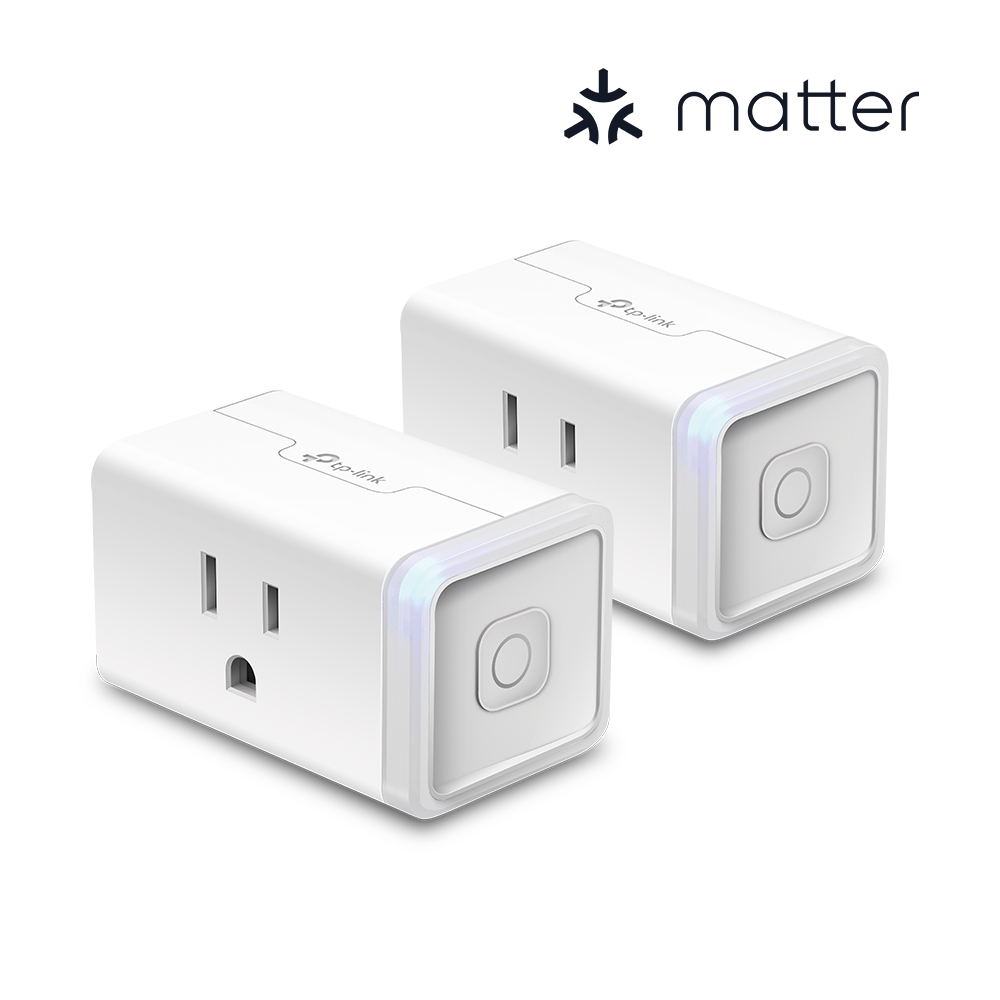
TP-Link's US category item 65728 identifies KP125MP2 V1. The product page selects that edition and lists two KP125M plugs; its package image shows two separate bodies. Each unit switches one outlet. It is useful to think of the offer as a pair of independent plug-ins rather than a dual-socket adapter, and not to combine their electrical figures into a larger package rating.
Package identity is more important here because the lifecycle status is specific. TP-Link's V6.0 US end-of-life table lists the KP125MP2 V1.0 two-pack with an end-of-sale date of February 20, 2026. That is a manufacturer lifecycle fact, not proof that every seller offer is old stock, that a listing is the right revision or that a particular unit is still under warranty. Check the label, condition, return policy and support path before buying.
Matter platform choice plus a Kasa energy view
The exact V1 product page and linked materials document Matter support, 2.4 GHz Wi-Fi, and Bluetooth used for setup. Apple Home, Alexa, Google Assistant and SmartThings are listed third-party platform routes. Matter does not remove the need to check the controller and app: TP-Link's setup material calls for a compatible Matter controller and the matching ecosystem app. The Kasa app is a separate documented route, and this assessment does not infer how the plug behaves locally if internet service fails.
Energy monitoring is an important app distinction. TP-Link advertises it for KP125M and describes energy use in Kasa, but the V1 datasheet says that energy monitoring is not supported in the Apple Home app. Apple Home compatibility through Matter therefore does not mean that Apple's app displays the energy report. If the report is important, plan to use the Kasa app; if it must appear in Apple Home itself, this configuration does not meet that documented requirement.
The Kasa route also documents weekly schedules, a countdown/auto-off timer and randomized Away Mode. Feature parity in third-party Matter apps is not guaranteed by the product's Matter logo. Decide which app will own each routine before pairing the device, especially if household members expect a single interface.
Per-plug load limits and body dimensions
The KP125M V1 materials specify 100–120 V, maximum 15 A and 1,800 W at 120 V for general/resistive use. The stated figures apply to each plug; they are not a 3,600 W pair rating or a circuit allowance. No separate motor horsepower ceiling is published in the reviewed V1 sources. A watt maximum does not establish approval for a compressor or motor, and the appliance's own switching instructions still apply.
TP-Link lists the housing at 2.6 inches high, 1.5 inches wide and 1.6 inches deep. Those body dimensions help compare the plug with a tight receptacle, but they do not account for a proud wall plate, a second outlet already occupied, a wide appliance plug or furniture behind the cord. Measure the actual installation. A compact-design claim is not an exact clearance guarantee.
The user guide specifies indoor use; there is no outdoor weather rating in this assessment. If the location is damp or exposed, choose a product explicitly documented for that environment rather than relying on a cover or enclosure to change the rating.
Who should consider this two-pack?
The MP2 fits an indoor scenario needing two separate switching points, a Matter path to a supported home platform, and Kasa-based monitoring or routines—provided the earlier package and per-appliance limits are acceptable. It is less suitable when a new/current edition is a hard requirement, when Apple Home must show energy data, when a motor ceiling is essential, or when offline operation must be documented.
Before buying, confirm the exact KP125MP2 V1 label and two-unit contents. Check the seller's warranty and return terms against the dated lifecycle entry, then verify the controller, app, Wi-Fi setup and Matter code requirements for your household. Compare each load independently with its own nameplate, and measure both intended outlets rather than assuming that both locations have the same clearance.
Bottom line
The KP125MP2 V1 two-pack has a well-documented Matter/Kasa split: third-party control is available through a compatible controller, while energy reporting belongs in Kasa rather than Apple Home. Its load rating is 15 A/1,800 W per plug for general/resistive use, with no separate motor figure. Because TP-Link's lifecycle list names this exact two-pack as end-of-sale, seller-version and condition checks are central to the decision. See the KP125MP2 page, its V1 support page and the TP-Link lifecycle table.
Key specifications
Key details at a glance
| Controlled outlets | One controlled outlet per plug |
|---|---|
| Reviewed package | 2-pack |
| Maximum current | 15 A |
| Maximum published watts at 120 V | 1800 W |
| Body height | 2.6 in |
| Body width | 1.5 in |
| Body depth | 1.6 in |
| Network and protocol | 2.4 GHz IEEE 802.11 b/g/n Wi-Fi; Bluetooth is for setup only; Matter-certified third-party integration needs a supported controller and app. |
| Indoor use only | Yes |
| Outdoor rating | No |
| Schedules documented | Yes |
| Countdown timer / auto-off | Yes |
| Away Mode | Yes |
| Matter controller for third-party app | Yes |
Use the exact model’s instructions for operating limits, supplied equipment and version differences.
Sources for this review
Sources for this assessment
- TP-Link US Smart Plugs catalog page 1
- TP-Link US KP125MP2 V1 product page and exact 2-pack route
- TP-Link US KP125MP2 V1 support and downloads
- TP-Link Kasa KP125M (US) V1 datasheet
- TP-Link Kasa KP125M (US) V1 user guide
- TP-Link Kasa KP125M (US) V1 quick installation guide
- TP-Link Kasa app guide for plug-series controls
- TP-Link Matter FAQ: hub and controller compatibility
- TP-Link Matter setup FAQ across Apple, Alexa, Google and SmartThings
- TP-Link US Smart Home EOL list V6.0, KP125MP2 V1.0
- CPSC SaferProducts exact product-name query for KP125MP2
Check the exact version against your own outlet
The finder checks documented ratings and features; it cannot approve your appliance, outlet wiring or physical clearance.