
Your needs, this model
Does it fit your priorities?
Does the four-pack multiply a single plug's load limit by four?
No. The manufacturer identifies four separate plug minis, not one shared four-outlet device. The exact V1 sources give appliance-specific examples but no overall current or watt limit; do not multiply a per-plug limit or infer a circuit rating from the pack count.
Explore this need in the finder →Does HS103P4 V1 have Kasa scheduling and Away Mode?
The HS103 (US) V1 guide documents recurring on/off schedules, a countdown timer and randomized Away Mode in Kasa. The guide is for the underlying HS103 unit and cautions that features can vary by model/software; this assessment does not transfer those routines to Alexa or another app, and does not claim live manual control during an internet outage.
Explore this need in the finder →Can the exact V1 plug be treated as a 15 A or 1,800 W device?
Not from the checked V1 sources. Its guide lists maximum examples for a heater, toaster, humidifier, tower fan and iron, but does not publish an overall current or watt rating. The 15 A / 1,800 W values documented for the separate HS103P3 V3.8 edition are not transferred to HS103P4 V1.
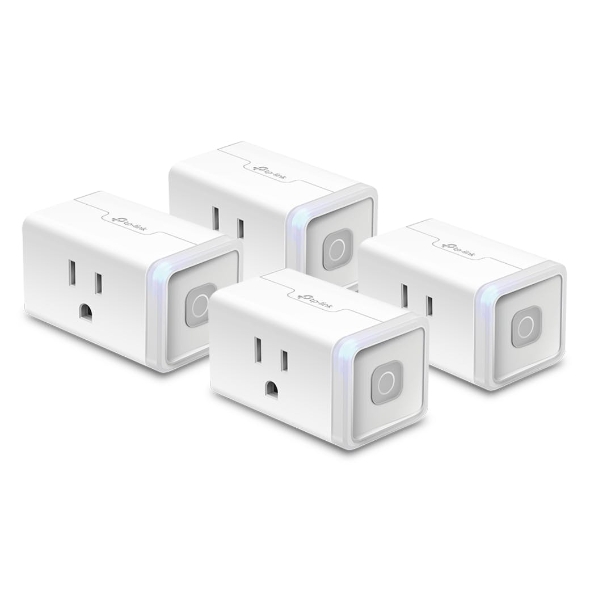
Explore this need in the finder →TP-Link's US product route identifies HS103P4 as a V1 four-pack of the Kasa Smart Wi-Fi Plug Mini. This is a source-based assessment, not a hands-on test. The package route and model-card image establish a four-plug format, while the exact comparison table leaves HS103P4's technical cells blank. To assess the plug itself, I used TP-Link's HS103 (US) V1 guide, which names the US HS103 unit as its example. That is a careful unit-level bridge, not proof of every accessory in a seller's box: the guide itself warns that features can vary by model and software version.
Four independent outlets, not one multiplied rating
HS103P4 is a pack of small, single-outlet plugs, rather than a strip or a multi-socket device. The exact TP-Link route calls it a four-pack, and the associated official image shows four plug bodies. Treat the devices as separate outlets: four units do not turn an unknown per-plug maximum into a larger package rating or a new branch-circuit allowance.
The V1 guide calls the design compact and says two plugs can be stacked in one wall outlet. That's useful when both receptacles are occupied by smart plugs, but it is not a dimensional drawing or a guarantee for every wall plate, oversized plug, transformer or cord bend. TP-Link's captured V1 comparison page provides no body dimensions. If an adjacent outlet or furniture is tight, measure the actual installation rather than assuming that the product image establishes clearance.
Kasa routines are the clearest strength
The HS103 (US) V1 guide describes setup in the Kasa Smart app, including sign-in with a TP-Link ID, and says no separate hub is needed for that arrangement. It documents schedules with selectable frequency, countdown timing that can switch the plug on or off, and Away Mode that randomizes switching to simulate occupancy. It also describes energy-usage tracking in the app. Those are useful capabilities for a lamp or ordinary household appliance that needs a recurring routine rather than a Matter-first installation.
The same boundary matters: the reviewed V1 guide documents Kasa, not Apple Home, Matter, Alexa, Google Home or SmartThings. The existence of those integrations on other Kasa products does not establish them here. Nor does a physical button plus Wi-Fi setup establish phone control after internet loss. The checked guide does not settle that offline behavior, a schedule's performance through an outage, exact radio band, or app feature parity with a different ecosystem. If an ecosystem or local-control requirement is essential, verify it on the exact hardware label and its own current documentation.
Appliance examples are not an overall electrical rating
The V1 guide lists supported load examples: heater up to 1,500 W, toaster up to 850 W, humidifier up to 260 W, tower fan up to 50 W and iron up to 1,500 W. These are the guide's appliance-specific figures; they are not a universal watt ceiling, an amperage rating, or a motor horsepower approval. The exact HS103P4 V1 comparison cells inspected for input, maximum load and maximum power are empty, and the V1 guide does not publish a single overall current or watt limit. The matcher therefore leaves those numeric limits unknown.
Do not substitute the 15 A / 1,800 W values documented for the separate HS103P3 V3.8 package, or ratings shown for EP10 or HS103P2 V3 in the same comparison table. Those are different model/version columns. If the appliance has a compressor, motor, heater or a duty-cycle restriction, use the appliance's own instructions and the exact plug's label; a small watt example is not a blanket safety clearance.
Dry indoor use and revision checks
The HS103 user guide describes a home plug and its safety section says to keep the device away from water, humidity, fire and hot environments. It is not an outdoor or damp-location choice. The guide also identifies the plug as a household-use device and explains its reset/configuration button and status light, but the captured V1 sources do not give the body size, a temperature range, or a detailed package inventory.
Revision is a practical concern, not a footnote. TP-Link's current HS103P4 support selector shows later hardware branches, while the selected route assessed here is V1 and its current US support path does not serve a matching V1 specification sheet. Sellers may list a similar HS103P4 package without guaranteeing which revision is in the box. Check the label, package quantity, return terms and the instructions that accompany the exact unit before purchase. No current stock or seller offer is established by this review.
Who should consider it?
The HS103P4 V1 four-pack is most defensible for someone who specifically wants several separate Kasa-operated indoor plugs and values schedules, a countdown, Away Mode or the guide's usage-tracking screen. Its compact-format claim may help when socket spacing is limited, provided a physical fit check agrees. It is not a good match for buyers who need an evidenced current/watt threshold, motor horsepower limit, measured body dimensions, an outdoor rating, or confirmed Matter/Apple Home and offline phone-control behavior. Those gaps are material; the V1 review keeps them unknown instead of borrowing neighboring-model numbers.
Bottom line: the official documents make the Kasa routine set unusually clear, but leave core electrical and dimensional fields open for this exact four-pack revision. Choose it only after you can confirm the V1 label and appliance instructions. A four-count package is a quantity, not a safety margin.
Key specifications
Key details at a glance
| Controlled outlets | One controlled outlet per plug |
|---|---|
| Reviewed package | US four-pack route |
| Motor limit | No separate horsepower limit is published in the exact V1 sources. The guide's 50 W tower-fan example is not a motor horsepower rating. |
| Network and protocol | The HS103 (US) V1 guide describes connection to home Wi-Fi and Kasa Smart app setup; it does not specify the radio band or IEEE standard. |
| Indoor use only | Yes |
| Outdoor rating | No |
| Schedules documented | Yes |
| Countdown timer / auto-off | Yes |
| Away Mode | Yes |
Use the exact model’s instructions for operating limits, supplied equipment and version differences.
Sources for this review
Sources for this assessment
- TP-Link US smart-plug catalog, page 1; HS103P4 item 51920
- TP-Link US HS103P4 V1 four-pack product route
- TP-Link US comparison page naming HS103P4 (4-pack) V1
- TP-Link Kasa Smart Wi-Fi Plug Mini HS103 (US) V1 user guide
- TP-Link US HS103P4 support route selected with V1 path; current page serves later branches
- TP-Link official HS103P4 four-pack image associated with the exact model card
- CPSC SaferProducts exact-name query for HS103P4

Check the exact version against your own outlet
The finder checks documented ratings and features; it cannot approve your appliance, outlet wiring or physical clearance.