
Your needs, this model
Does it fit your priorities?
Does the two-pack let me draw 30 A from one outlet?
No. HS103P2 means two separate one-outlet plugs, not one double-capacity adapter. TP-Link publishes a 15 A maximum for each plug; two package units do not raise the limit of either device, the wall receptacle or the branch circuit. Compare the actual appliance nameplate and instructions with the limits for the individual plug and circuit.
Explore this need in the finder →What is the V3 route's documented load ceiling for an appliance?
TP-Link lists 1,800 W for general use at 120 V, 15 A resistive at 120 V, and a separate 1/6 hp motor ceiling. Those figures describe different checks; satisfying one does not prove a motor, compressor, heating appliance or branch circuit is appropriate. The exact seller suffix still needs to match the V3 evidence.
Explore this need in the finder →Which automatic routines are documented for this Kasa two-pack route?
The V3 product page lists schedule, timer and randomized Away Mode functions through Kasa. It also names Alexa, Google Assistant and SmartThings integrations. It does not establish that the app can switch the plug locally during an internet outage, or that this route reports energy consumption or works with Matter or Apple Home.
Explore this need in the finder →The Kasa HS103P2 V3 is a pair of small, indoor Wi-Fi plugs for someone who wants two separate switched outlets rather than a single multi-socket adapter. The useful question is not just whether it connects to Kasa: this model family has materially different published load figures across hardware generations, and the product page has a package-content line that does not agree neatly with its two-pack presentation. This review treats the observed US V3 route as a two-device assessment while keeping both the seller-revision and package checks visible.
Two plug bodies, one rating per plug
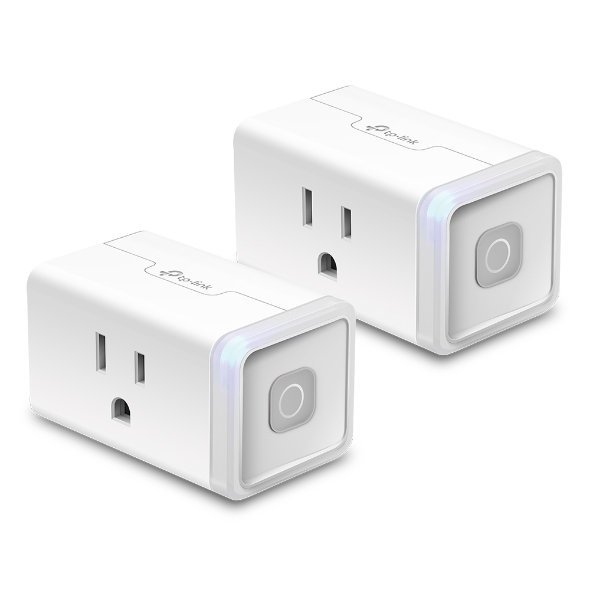
TP-Link's US smart-plug category identifies HS103P2 as item 46633, version V3. Its product overview names the Kasa Smart Wi-Fi Plug Mini as a “2-Pack,” the model suffix points to the paired configuration, and the manufacturer gallery shows two plug bodies. A TP-Link US lifecycle row also identifies HS103P2 V3.8 as a two-pack. There is a real wrinkle: the page's generic “Package Content” specification lists one Kasa Smart Wi-Fi Plug and a quick-start guide. That text may describe the device family rather than settle this exact retail route; it should not be hidden. Check that the particular offer contains two units and that the printing on each device is compatible with the V3 assessment.
Each plug is a single controlled outlet. The package does not combine the devices into one 30 A appliance connection, and it does not increase a wall outlet or circuit's capacity. TP-Link lists 15 A resistive at 120 V, 1,800 W for general use, and a separate 1/6 hp motor maximum for the V3 specification. Apply those limits to the individual plug and compare them with the load's own label and instructions. A device's startup behavior, a compressor's requirements, wiring condition and the branch-circuit limit remain outside this document-based match.
Do not transfer an earlier revision's numbers
“HS103P2” alone does not prove which hardware revision a seller will supply. TP-Link's product and support pages expose distinct V1 and V3 branches, and the supporting documentation describes a broader set of hardware suffixes. The V1 page reports a lower 13 A resistive / 1,200 W general-use ceiling than the V3 page, while both show a 1/6 hp motor limit. Those are not interchangeable specifications. This assessment uses the V3 product page and the V3-linked HS103 datasheet; it does not silently grant a V1 unit the higher V3 wattage.
The manufacturer lifecycle table records an earlier HS103P2 V3.8 US two-pack with historic end-of-sale and end-of-support dates. The category itself labels the product V3, but no seller box or label has been examined here to prove a full V3.0, V3.6 or V3.8 suffix. Treat it as an earlier route for comparison, not as evidence that a seller has stock, that a listing contains the assessed revision, or that any particular warranty remains in force.
Useful Kasa routines, with a cloud boundary
The V3 product page documents Kasa app control, schedule and timer functions, and randomized Away Mode. It also names Alexa, Google Assistant and SmartThings as voice or smart-home integrations. That is a straightforward package for two separate lamps or other compatible indoor loads when a shared Kasa workflow is more important than energy reporting. The control path is 2.4 GHz Wi-Fi; Bluetooth, Matter or an Apple Home route is not established by the selected US V3 material.
Remote app control and routines do not prove that the app can continue controlling the device locally after an internet connection fails. The available selected-version sources do not settle that behavior, and they do not establish energy-use monitoring. If either capability is a must-have, keep this pair out of that shortlist unless documentation for the exact device and app version closes the gap. A physical button is not the same thing as offline app control.
Small body, but measure the installation
The product page gives a body size of 2.62 × 1.57 × 1.50 inches in height × width × depth order. The shallow 1.5-inch depth may help where a plug projects from a wall, but the figure is only the plug body: it does not account for the wall plate, the unused receptacle, neighboring adapters, a cord head or furniture. The “compact” marketing claim is not a fit guarantee. Measure the particular outlet and allow room to insert and remove the device without forcing a tight cord bend.
TP-Link marks the unit for indoor use only. A covered outdoor outlet or a sheltered porch does not change that rating; choose a model specifically documented for the environment if exposure is part of the job. The Kasa phone app also requires setup against the appropriate 2.4 GHz network, so confirm signal coverage at both intended outlets rather than assuming that one successful location settles the second.
Who should keep it on the shortlist?
The HS103P2 V3 route is worth comparing when a buyer wants two independent one-outlet smart plugs for dry indoor locations and values the documented Kasa schedules, countdown timer or Away Mode. Its value depends on getting the exact two-unit package and V3-equivalent hardware, then checking every appliance against the per-plug limits. If precise metering, outdoor approval, Matter, Apple Home or confirmed local operation during an internet outage is essential, the reviewed evidence does not support treating this package as the answer. The full finder can compare the documented load and ecosystem requirements, but it cannot approve an appliance or prove that a retail offer matches its model page.
Key specifications
Key details at a glance
| Controlled outlets | One controlled outlet per plug |
|---|---|
| Reviewed package | 2-pack: two independent one-outlet plugs |
| Maximum current | 15 A |
| Maximum published watts at 120 V | 1800 W |
| Motor limit | 1/6 hp per plug |
| Body height | 2.62 in |
| Body width | 1.57 in |
| Body depth | 1.5 in |
| Network and protocol | 2.4 GHz IEEE 802.11 b/g/n Wi-Fi and Kasa app control; the exact seller hardware subrevision should be checked. |
| Indoor use only | Yes |
| Outdoor rating | No |
| Schedules documented | Yes |
| Countdown timer / auto-off | Yes |
| Away Mode | Yes |
Use the exact model’s instructions for operating limits, supplied equipment and version differences.
Sources for this review
Sources for this assessment
- TP-Link US Smart Plugs category, page 1; HS103P2 item 46633
- TP-Link US HS103P2 product page, V3 route
- TP-Link US HS103P2 V3 support and downloads
- TP-Link HS103 V3 datasheet linked from the V3 support route
- TP-Link US Smart Home EOL list V6.0, HS103P2 V3.8 entry
- CPSC SaferProducts exact-name HS103P2 query
Check the exact version against your own outlet
The finder checks documented ratings and features; it cannot approve your appliance, outlet wiring or physical clearance.